
EAC declaration of conformity for the Russian market: how it differs from a certificate

A declaration of conformity is the second form of EAC assessment. It carries the same weight at the Russian border as a certificate: without it, goods covered by a technical regulation are not released for free circulation, and no marketplace or retail chain in Russia will take them. What differs is who takes the decision and who answers for it.
That difference misleads exporters into treating the declaration as the light option. It is cheaper and faster, but the responsibility sits closer to you, and the two cases at the bottom of this page show what happens when the evidence behind it is thin.
- Certificate or declaration: which applies to your product
- Which products are declared
- Who may register a declaration
- What the declaration rests on
- The details that get declarations reissued
- From our practice
- FAQ
- Is a declaration weaker than a certificate?
- Can we register a declaration ourselves from China or Turkey?
- Is the declaration valid in Kazakhstan and Belarus?
- How long does a declaration last?
- What can an inspection ask for?
- + 2 more questions+ 5 more questions
Certificate or declaration: which applies to your product
Both documents are mandatory where the regulation requires them, both are entered in the state register, and both allow EAC marking. They differ in who takes responsibility and how the assessment is carried out.
A certificate of conformity is issued by an accredited certification body, which examines the evidence and answers for its decision. It applies to higher-risk groups: machinery, low-voltage products, protective equipment, pressure equipment. For serial production the scheme normally includes assessment of the production site and periodic surveillance.
A declaration of conformity is registered by the applicant, who takes responsibility for the statement, on the basis of test reports and the technical file. It is cheaper and faster, but the obligations are not lighter: an inspection can request the evidence base at any time, and a declaration unsupported by real testing is worthless.
You do not choose between the two. The applicable regulation states which form of assessment your product requires, and some products need several documents at once — a piece of electrical equipment typically requires assessment under both TR CU 004 and TR CU 020. We determine this at the identification stage, before any money is spent on testing.
Which products are declared
Declaration covers the larger share of consumer goods and lower-risk industrial products. Typical groups exporters ask us about:
- Food products under TR CU 021, with additional regulations for specific categories: juices, oils and fats, dairy, and labelling under TR CU 022.
- Textiles, clothing and footwear under TR CU 017, and products for children and adolescents under TR CU 007, where the risk class decides between declaration and certification.
- Furniture under TR CU 025, including the load and stability requirements that catch out cheap fasteners.
- Household electrical goods under TR CU 004 and TR CU 020, where two documents are the norm rather than the exception.
- Perfumery and cosmetics under TR CU 009, with state registration required on top for certain categories.
Which regulation applies is decided by what the product is and by its HS code. Products that fall outside every regulation need no EAC document at all, and in that case what you need is a rejection letter confirming it — useful at customs and free to establish during identification.

Who may register a declaration
The applicant must be a legal entity or an individual entrepreneur registered in a member state of the union. A foreign manufacturer cannot register a declaration in its own name from abroad: it is filed either by the importer or seller, or by a person authorized by the manufacturer to act inside the union. Registration itself is electronic and requires the applicant's qualified digital signature, which is one more reason the role cannot be performed from outside.
That person carries the responsibility attached to the statement, which is why we take the role knowingly and only for products we have tested. See authorized representative in the EAEU for what the arrangement involves on both sides.
What the declaration rests on
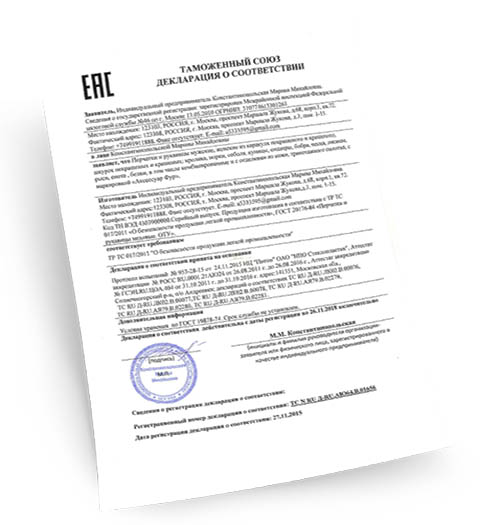
Declaration of conformity of the Customs Union — the form your document takes
The declaration itself is a short document. The evidence behind it is not, and it is the evidence that an inspection asks for. Depending on the scheme, the file includes test reports from an accredited laboratory, the technical documentation of the product, a description of production control, and documents identifying the manufacturer and the goods. Some schemes allow the applicant's own evidence base; others require reports from an accredited laboratory, and the regulation decides which, not the applicant.
The scheme also depends on what the document covers. A declaration for serial production is valid for up to five years and covers everything you ship in that period. A declaration for a single consignment has no expiry date but covers only that batch, identified by contract and quantity.
A declaration registered without genuine testing is the most common form of paper sold to foreign manufacturers. It looks identical in the register until someone asks for the reports behind it, and then the document is cancelled, the goods are withdrawn and the money is gone. Testing in our own accredited laboratory is what stands behind every declaration we register.
- Documents for the Russian market from $50 — one declaration valid in all five EAEU countries
- Testing in our own accredited laboratory, accreditation certificate RA.RU.11NK91
- We can act as your applicant in the union if you have no importer yet
Send us your product details and get a quote within one business day — WhatsApp, WeChat or e-mail.
The details that get declarations reissued
A declaration is easy to file and easy to file wrong, and the errors surface at the worst moment: when a wholesaler checks the register against the packaging, or when an inspector does. The recurring ones are mundane. Data on the label that does not appear in the declaration, or appears differently. A production or packing site left out. A model designation that does not match what is printed on the product. Test reports that cover a neighbouring model rather than the one being shipped.
None of these are technical failures of the product. They are documentation failures, they invalidate the document just as effectively, and correcting them means registering again while the goods wait.
From our practice
Folding chairs that folded. The paperwork on a consignment of Chinese folding chairs was in order, but during routine testing the chairs collapsed under the test dummy. The cause was not the design: the manufacturer had used cheap fasteners that failed at 50–55 kg, while TR CU 025 requires stability up to 100 kg. The consignment never reached the Russian market. Had the importer bought a declaration registered without testing, the defect would have been found by whoever sat down, and the liability would have rested with the person who registered it. Full case (in Russian).
A tea supplier who filed its own declaration. The packaging showed the packing address; the declaration under TR CU 021 did not mention it. The two have to match. Wholesale partners noticed, deliveries were missed, and the dispute was heading towards court before the declaration was reissued correctly. The company had exercised its right to declare its own products, and the missing line cost it far more than the procedure would have. Full case (in Russian).
Iranian saffron and the word of the supplier. The exporters were certain their product spoke for itself, and by every account the saffron was excellent. Origin, however, has to be documented rather than asserted: papers had to be requested from the authorities in Iran and translated from Farsi before the assessment could proceed. Quality is not evidence, and a supplier's confidence is not a test report. Full case (in Russian).
FAQ
Is a declaration weaker than a certificate?
No. Both are mandatory where the regulation requires them, both appear in the state register and both permit EAC marking. The difference is procedural: a body decides on a certificate, while the applicant declares and answers for the statement.
Can we register a declaration ourselves from China or Turkey?
No. Registration is electronic and requires an applicant registered in a member state with a qualified digital signature. Your importer can do it, or we can, acting as your authorized representative.
Is the declaration valid in Kazakhstan and Belarus?
Yes. A declaration registered in any member state is valid in all five, and no separate national document is needed.
How long does a declaration last?
Up to five years for serial production. A declaration for a single consignment has no expiry date but covers only that batch.
What can an inspection ask for?
The evidence base behind the declaration: test reports, technical documentation, production control, and identification of the manufacturer and the product. Keeping that file complete and available inside the union is part of what we take on as applicant.
Related: EAC certificate of conformity, authorized representative in the EAEU, or the overview of certification for export to Russia and the EAEU.
Leave your name and a way to reach you — we will take it from there. We reply within one business day.
Ещё один шаг
Мы обрабатываем имя и контакты только для ответа на эту заявку — не передаём третьим лицам и не используем для рассылок. Нужно ваше согласие.
Отметьте согласие — и заявка уйдёт сразу.
· Esc