
State registration certificate (SGR): mandatory for cosmetics, supplements, water and household chemicals
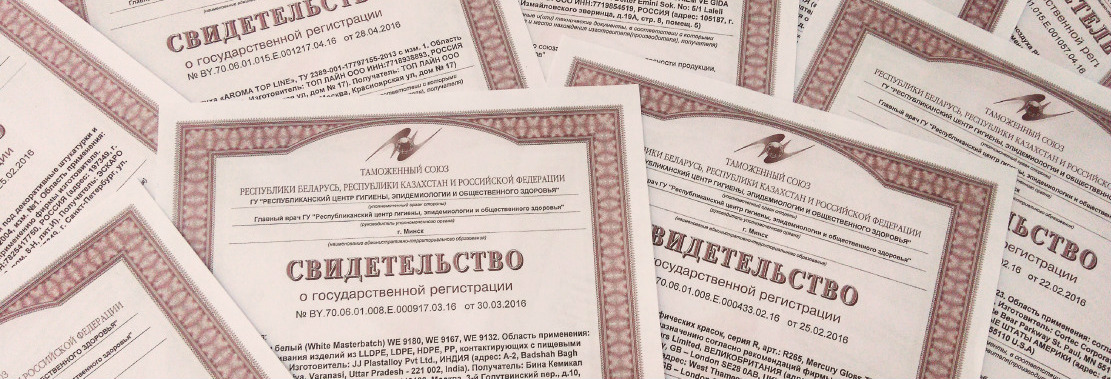
Exporters who have dealt with EAC marking often assume it covers everything. For a large group of products it does not. Cosmetics, dietary supplements, bottled water, baby goods and household chemicals fall under sanitary and epidemiological supervision, and before they may be imported, produced or sold anywhere in the Eurasian Economic Union they must be entered in a state register. The document confirming that entry is the state registration certificate, known by its Russian abbreviation SGR (svidetelstvo o gosudarstvennoy registratsii).
In Russia it is issued by Rospotrebnadzor, the federal consumer protection and public health service, and by equivalent authorities in the other member states. One certificate is recognised across all five countries — Russia, Kazakhstan, Belarus, Armenia and Kyrgyzstan — so registration is done once, not five times. Below: which products need it, who may apply, what a foreign manufacturer has to supply, and where the procedure usually goes wrong.
- How SGR differs from an EAC certificate or declaration
- Which products require state registration
- Who can apply: the obstacle specific to foreign companies
- Documents required from a foreign manufacturer
- Testing: why foreign test reports are not enough
- How the procedure runs, and how long it takes
- Dietary supplements: what the certificate does not say
- Cosmetics and household chemicals
- From our practice
- FAQ
- Is one certificate enough for all EAEU countries?
- Can the certificate be issued to us as a foreign manufacturer?
- Will our existing test reports be accepted?
- Does the certificate expire?
- What happens if we ship without it?
- How much does registration cost?
- + 3 more questions+ 6 more questions
How SGR differs from an EAC certificate or declaration
The two systems run in parallel and answer different questions. An EAC certificate or declaration of conformity confirms that a product meets a technical regulation, and is registered with the Federal Accreditation Service. The SGR confirms compliance with the Uniform Sanitary and Epidemiological Requirements — limits on toxic substances, heavy metals, microbiology, composition and labelling — and is registered with the health authority.
For many goods both are required, and this is the point most exporters miss. Bottled water needs an SGR and a declaration. Cosmetics need a declaration under TR CU 009 and, for the categories named in the register list, an SGR as well. Neither document substitutes for the other, and customs will ask for whichever is missing.
A third document exists for the gap between them: if your product is not on the registration list but a buyer or an inspector still wants proof of sanitary safety, the answer is an expert conclusion rather than an SGR. We establish which of the three applies before any money is spent.
Which products require state registration
Registration applies only to goods named in Section II of the Uniform List of products subject to sanitary and epidemiological supervision. The main groups are:
- baby food;
- children's clothing in contact with the skin, tableware and childcare articles for children under three;
- cosmetics and personal hygiene products;
- bottled water — drinking, table and mineral;
- dietary supplements and specialised nutrition;
- food products containing GMOs;
- alcoholic, low-alcohol and tonic beverages;
- paints, primers, mastics, fillers and household chemicals;
- materials and articles intended for contact with food, other than tableware and equipment.
The list is read by what the product is and what it is for, not by the category name on your invoice. A cream marketed for children under three and the same formula sold as an adult product are treated differently, and that difference decides whether you need a registration at all.
Who can apply: the obstacle specific to foreign companies
An SGR cannot be issued to a company registered outside the Union. The applicant has to be a manufacturer located in the EAEU, or a legal entity registered in a member state and authorised to act on the manufacturer's behalf. A foreign exporter with no presence in the Union cannot hold the certificate in its own name, however complete the technical file.
There are two ways round it. The certificate can be issued to your importer — simple, but it ties the document to one buyer, who then controls your access to the market. Or it can be issued to an authorized representative acting for you, which keeps the registration in your control and lets you supply several importers from one document. We provide that service, and for anyone planning more than a single shipment it is the arrangement that makes sense.
Documents required from a foreign manufacturer
- Company details of the manufacturer and the applicant, and the authorisation between them.
- Full quantitative composition or formulation, with the function of each ingredient.
- The specification or standard the product is manufactured to, and its shelf life.
- Consumer labels, package artwork and instructions for use — in the form they will reach the buyer.
- A free sale certificate confirming the goods are legally sold in the country of manufacture.
- A quality certificate and any test reports issued in the country of manufacture.
- Product samples, with a sampling report.
The free sale certificate catches people out. It is routine in most jurisdictions, but some chambers of commerce take weeks over it and registration cannot proceed without it — request it early, not after the samples are already in the laboratory.
Testing: why foreign test reports are not enough
Registration is granted on laboratory results, and those results must come from a laboratory accredited within the Union and listed in the national accreditation register. Reports issued abroad are reviewed as supporting evidence but do not replace testing here: the parameters and permitted limits differ from those in the EU, the United States or China, and the authority verifies against its own.
We run our own accredited laboratory, so the schedule is ours rather than a queue at a third party, and the report cannot be rejected over somebody else's lapsed accreditation — a failure that restarts the whole procedure, and a common one when the work is subcontracted down a chain.
- State registration certificate from $700 — valid in all five EAEU countries, no expiry date
- We act as your authorized representative — the registration stays yours, not your importer's
- Testing in our own accredited laboratory — no subcontractors, no rejected reports
Send the composition and the label — we will tell you free of charge whether an SGR is needed and what it will cost. WhatsApp, WeChat or e-mail.
How the procedure runs, and how long it takes
Samples are tested against the sanitary limits for the product group, then the results and documents go to the health authority, which examines the composition, the test data and the labelling claims. If everything holds, the certificate is entered in the unified EAEU register, where any customs officer, marketplace or buyer can verify it by number.
Most of the calendar time is laboratory work and official review, and both depend on the product group — the panel for a mineral water is not the panel for a hair dye. With samples in hand and a complete file it moves faster, which is why we settle the document list before the samples ship. An expedited route is available for some categories.
The certificate has no expiry date. It stays valid as long as the product, its composition and the requirements remain as registered — reformulate, and it no longer describes what you are selling.

The certificate names the product, the manufacturer and the applicant, and carries the register number
Dietary supplements: what the certificate does not say
Supplements are always registered — an SGR, not a declaration. What surprises manufacturers is that registration confirms the safety of the composition and nothing else. A supplement is legally a food product, not a medicine, so claims about treating or preventing disease have to come off the label before the file is accepted. Copy written for a market where such wording is tolerated needs rewriting for this one, and we go through the label with you.
Cosmetics and household chemicals
Cosmetics, perfumery and household chemistry — cleaning, washing and disinfecting products — are assessed for toxicity, skin and eye irritation, pH and microbiology. Cosmetics also need a declaration under TR CU 009, so this group usually ends up with two documents and a label that has to satisfy both. We prepare them together, so the artwork is printed once.
From our practice
Ten colours, ten certificates. Registering a paint range in Belarus, we found the authority there insists the certificate names the specific colour. Register one shade and that is the only shade you may sell; ten shades mean ten separate registrations, with the cost that implies. The upside is that a Belarusian document is respected precisely because the checking is that thorough, and some clients ask for that route deliberately. Full case (in Russian).
Chinese hygiene products for a marketplace. An importer of herbal suppositories from China needed to sell on Wildberries, which meant an SGR as a personal hygiene product plus the platform's own document. Given where the product is used, our experts went through the composition ingredient by ingredient, checked combinations for allergic potential, and tested for toxic substances, heavy metals, microbiology and pH. The manufacturer's Chinese clinical data was reviewed alongside — supporting material, not a substitute for testing here. Full case (in Russian).
A supplement that promised too much. A liquid collagen product arrived with a label claiming prevention of glaucoma, cataracts, arthritis, osteoporosis and more besides, oncology included. None of that can be confirmed by assessing a food product, whatever the laboratory finds. We documented what was true — conformity with TR CU 021 and TR CU 029, a safe composition of vitamins, minerals and dietary fibre — and brought the claims back to what the evidence supported. Full case (in Russian).
FAQ
Is one certificate enough for all EAEU countries?
Yes. An SGR issued in any member state is recognised in all five and appears in the unified register. You register once.
Can the certificate be issued to us as a foreign manufacturer?
Not directly. The applicant has to be registered in the Union — your importer, or an authorized representative acting for you. The second route keeps the document in your control and lets you work with several importers.
Will our existing test reports be accepted?
We always review them, but registration requires testing in a laboratory accredited within the Union. Send what you have and we will tell you what has to be repeated.
Does the certificate expire?
No. It stays valid while the product, its composition and the requirements remain as registered. A reformulation or a change in the rules calls for a new one.
What happens if we ship without it?
Goods from the registration list are stopped at customs, and selling them unregistered carries fines up to 500,000 roubles plus seizure of the consignment. Marketplaces block the listings on the same basis.
How much does registration cost?
It depends on the product group and the tests it calls for — a mineral water, a hair dye and a supplement are three different pieces of work. We quote free of charge once we have seen the composition and intended use, and the figure goes into the contract.
Related: authorized representative in the EAEU, EAC declaration of conformity, accredited testing and test reports, documents for Russian marketplaces.
Leave your name and a way to reach you — we will take it from there. We reply within one business day.