
Technical documentation in Russian: specifications, passports and manuals
A certificate is not the only paper a product needs. The technical regulations require documentation that travels with the goods and is written in Russian: what the product is and what it is made of, how to use it safely, what the label must state. Buyers read it, inspectors check it against the product, and customs compare it with the declaration. A perfectly certified product with an English-only manual is still not ready for the market.
For a foreign manufacturer this is rarely a translation job. Russian documentation follows its own structure and its own standards, and a literal translation of a European datasheet produces a document that says the right things in the wrong form. We prepare the documentation from your technical materials, in the format the regulation and the buyer expect.
- What documentation your product needs
- Why translation is not enough
- How we work with your materials
- When the standard is older than your product
- From our practice
- FAQ
- Can we just translate our existing manual?
- Do we need technical specifications if we have a certificate?
- Who is responsible if the label does not match the document?
- Can you prepare documentation without doing the certification?
- What language do we send our materials in?
- + 2 more questions+ 5 more questions
What documentation your product needs
- Technical specifications (TU). The document defining your product where no suitable standard exists or where you supply to a specification of your own. It states composition, parameters, acceptance rules, test methods, packaging, marking, storage and warranty terms, and it becomes the reference the product is checked against.
- Product passport. The document accompanying an item, stating its identification, parameters, completeness and manufacturer. Required for most equipment, and the first thing a buyer asks for when a unit arrives without one.
- Operating manual. Installation, operation, safety, maintenance, transport and disposal. Required by regulations covering machinery and equipment, and expected commercially far beyond them.
- Labelling and packaging text. The single-language requirement that catches out almost every first-time exporter: the label has to be in Russian and has to match the registered document exactly.
- EAC marking. Applied to the product, the packaging or the accompanying documents once the assessment is complete, in a form that survives normal handling.
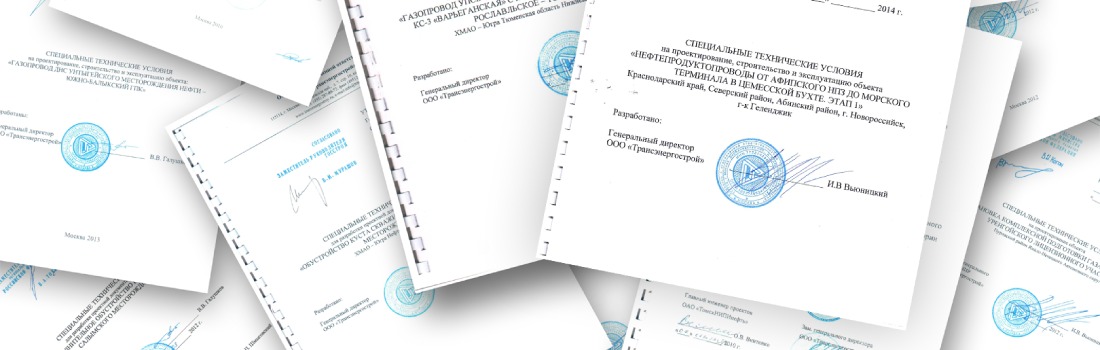
Below is a sample of technical specifications (TU) we prepared, in Russian as issued, so you can see the structure and the level of detail expected:


Why translation is not enough
Three differences trip up documents brought straight from the home market. Structure: Russian technical documentation follows a defined composition, and an inspector looking for a section expects to find it where the standard places it. Terminology: material grades, protection classes and climatic designations have their own systems, and a term translated by meaning rather than by equivalence turns into a claim your product cannot support. Requirements: the regulation may demand information the original document never carried, from disposal instructions to shelf-life statements.
The label deserves particular attention, because it is the cheapest thing to get wrong and one of the most expensive to fix. Everything printed on it has to correspond to the registered document, and every discrepancy is visible to anyone comparing the two. A packing address on the packaging but missing from the declaration is enough to stop deliveries, as one supplier discovered after filing its own paperwork.
- Technical specifications, passports, manuals and labelling prepared in Russian — from $50
- Documents consistent with your certificate or declaration, not translated in isolation
- Testing in our own accredited laboratory, accreditation certificate RA.RU.11NK91
Send us your technical materials and get a quote within one business day — WhatsApp, WeChat or e-mail.
How we work with your materials
You send what you have: datasheets, drawings, manuals, test data, photographs of the product and its nameplate, in your own language. Documentation in Chinese, Turkish or German is normal rather than a complication, and translation is part of the work rather than a prerequisite for starting it.
From those materials we establish what the regulation requires for your product, identify the gaps, and ask for the missing parameters rather than inventing them. The documentation is then drafted in Russian and cross-checked against the certificate or declaration so that the model designations, the manufacturer details and the production site are identical everywhere. Documents written independently of the assessment are how contradictions appear, and contradictions are what inspections find.
When the standard is older than your product
Modern products regularly fall under standards written decades ago, and the gap has to be bridged rather than ignored. The workable approach is a hybrid: the requirements of the standard in force, plus the parameters and methods your technology actually needs, documented so that the result satisfies the regulation without pretending your product is something else. Both cases below came down to exactly that.
From our practice
Technical specifications for Hi-Fi audio equipment. The existing standards long predated the technology. The work meant requesting the manufacturer's technical documentation, translating part of it from a foreign language, researching current data, and then adapting the old standards into specifications that described the equipment as it actually is. Full case (in Russian).
Swedish furniture and meditation before assembly. Reviewing the operating manual for imported furniture, our experts found an instruction to meditate before assembly — included, the manufacturer explained, to achieve inner calm and prevent family arguments during the process. The declaration under TR CU 025 went through regardless: the regulation cares about structural strength, material safety and the quality of the accompanying documentation, and the manual met the requirements. Unusual content is not the problem. Missing content is. Full case (in Russian).
FAQ
Can we just translate our existing manual?
Sometimes, if the original already covers what the regulation requires and the terminology maps correctly. More often the translation is the starting material and the document is restructured. We tell you which case you are in after reading what you have.
Do we need technical specifications if we have a certificate?
They serve different purposes. The certificate confirms conformity; the specifications define what the product is, and they are the reference used when goods are checked against their documents. Whether they are required depends on the product and whether a suitable standard already covers it.
Who is responsible if the label does not match the document?
The party that placed the goods on the market, which is why we cross-check labelling against the registered document rather than treating it as a separate job.
Can you prepare documentation without doing the certification?
Yes, documentation is available on its own. It is usually cheaper together with the assessment, since much of the underlying work overlaps.
What language do we send our materials in?
Whatever you have. Chinese, Turkish, German and English materials are routine, and translation is included in the work.
Related: EAC certificate of conformity, accredited testing, authorized representative in the EAEU.
Leave your name and a way to reach you — we will take it from there. We reply within one business day.