
Exemption letter: proof that your product needs no EAC certificate
Not every product needs an EAC certificate. A large share of what crosses the Russian border and sells online falls outside every technical regulation, and for those goods no certificate exists to be obtained. The difficulty is that customs officers, marketplaces and buyers all ask the same question — where are your documents — and "we do not need any" is not an answer anyone accepts on trust.
The document that answers it is an exemption letter, known in Russian practice as otkaznoe pismo and sometimes translated as a rejection or refusal letter. It is a written conclusion from a certification body stating that a specific product, identified by description and HS code, is not subject to mandatory conformity assessment. It costs a fraction of certification, it is issued in days rather than weeks, and for many sellers it is the only document they ever need.
- What it is, and what it is not
- When you are asked for one
- Which products usually fall outside the regulations
- What we need from you
- How long it takes and how long it lasts
- From our practice
- FAQ
- Is an exemption letter an official document?
- Can you issue one for any product?
- Will customs definitely accept it?
- Does it expire?
- Do we need one for every item in the range?
- The marketplace asked for a certificate, not a letter. What now?
- + 3 more questions+ 6 more questions
What it is, and what it is not
We tell you on every other page of this section to verify documents in the state register of the Federal Accreditation Service, so this needs saying plainly: an exemption letter is not in that register, and it never will be. It is not a state permit. It is an expert conclusion issued by a certification body on the basis of the product description, the HS code and the applicable regulations, and it is accepted precisely as that.
The distinction from a fake certificate matters. A forged or unbacked certificate claims a status it does not have and collapses the moment anyone checks the number. An exemption letter claims nothing beyond what it says: these goods do not fall under mandatory assessment, and here is the reasoning. Customs and marketplaces accept it because it answers their question and because the body that signed it takes professional responsibility for the analysis.
What it cannot do is exempt goods that are actually regulated. If your product falls under a technical regulation, no letter changes that, and any company offering one for such goods is selling you a problem rather than a document. The case at the bottom of this page is exactly that situation.
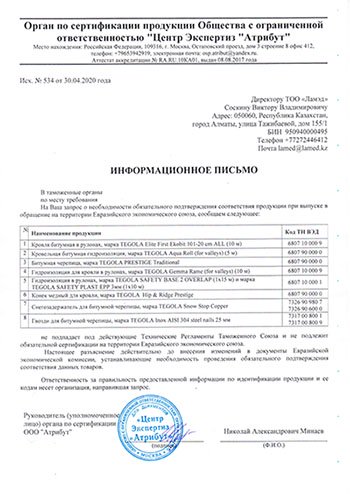
An exemption letter lists the goods and their HS codes, and states that they are not subject to mandatory assessment
When you are asked for one
- Customs clearance. The officer needs to see why no certificate accompanies the consignment.
- Marketplaces. Ozon, Wildberries and Yandex Market request documents for product cards, and for unregulated categories the exemption letter is what closes the request. See documents for Russian marketplaces.
- Retail chains and distributors. Procurement departments file it with the contract.
- Tenders and corporate buyers. Often part of the standard document package.
- Banks and contract paperwork, where the counterparty asks for the goods to be documented.
Which products usually fall outside the regulations
There is no fixed list, because the answer depends on what the product is, what it is for and how it is presented. In practice we most often issue exemption letters for decorative and souvenir goods, artists' and hobby materials, certain accessories, spare parts and components supplied for further assembly, some categories of equipment intended for industrial rather than consumer use, and various goods that are simply not named in any regulation.
The same object can land on either side of the line depending on its purpose. A figurine sold as a collectible for adults is not a toy; the same figurine marketed for children falls under the toy safety regulation with mandatory certification. A thermometer for domestic use and a thermometer built into a piece of regulated equipment are assessed differently. This is why identification is done on the actual product and its intended use, not on the category name in your price list.
- Exemption letter from $50 — issued in a matter of days, accepted by customs and marketplaces
- We establish free of charge whether your product needs a certificate, a declaration or nothing at all
- If the product turns out to be regulated, we tell you straight and quote the real procedure
Send us the product description and photographs — WhatsApp, WeChat or e-mail.
What we need from you
- Product name and a clear description of what it is and what it is used for.
- HS code, if you know it — and we will establish it if you do not.
- Photographs of the product and its packaging, including any text printed on it.
- Technical specification or datasheet, where the product has technical parameters.
- Intended audience: consumer goods, professional or industrial use, goods for children.
The packaging matters more than people expect. Wording aimed at children, medical claims or promises about health effects can pull an otherwise unregulated product into a regulation on their own, and it is better to discover that before the goods are printed and shipped.
How long it takes and how long it lasts
No testing is involved, so the work is analysis rather than laboratory time: a letter is normally ready within a few days of receiving the description. It is issued for the product as described, with the HS code stated, and it does not carry an expiry date in the way a certificate does.
That said, regulations change and product ranges shift. If a new regulation brings your category into scope, or if you change the product, the letter no longer describes reality and a new assessment is needed. We flag it when a category is in the middle of such a change.
From our practice
The client who wanted an exemption letter for children's toys. The request looked routine: a letter, quickly, to start selling on Wildberries and Ozon. Toys, however, fall under TR CU 008 and require mandatory certification, so we refused to issue the letter and explained what was actually needed — the certificate first, and a voluntary one afterwards if the seller wanted the marketing benefit. Saying no cost us that order and saved the client a blocked listing and a fine. Full case (in Russian).
Finnish sauna thermometers that start at 80°C. Our experts asked the manufacturer why the scale had no lower readings. The answer was that below 80 it is not a sauna but a warm room, and in Finland that is not a serious proposition. Thermometers of this kind are not subject to mandatory assessment, so the goods went to market on an exemption letter, and the importer added a voluntary certificate to confirm accuracy and material safety to buyers. Full case (in Russian).
FAQ
Is an exemption letter an official document?
It is an official conclusion of a certification body, not a state permit, and it is not registered in the state register. That is its normal status, and customs and marketplaces accept it on that basis.
Can you issue one for any product?
No. Only for products genuinely outside mandatory assessment. If your goods are regulated, we say so and quote the certification or declaration instead.
Will customs definitely accept it?
It is accepted when it identifies the goods precisely and states the HS code that matches the customs declaration. Mismatched descriptions are the usual reason a letter is questioned, which is why we work from the actual product data rather than a category name.
Does it expire?
It has no expiry date, but it describes the product and the regulations as they stand. A change to either means the letter needs revisiting.
Do we need one for every item in the range?
One letter usually covers a group of similar goods under the same HS code. Where the range spans different codes or different purposes, the letter is split accordingly.
The marketplace asked for a certificate, not a letter. What now?
Send us the request and the product card. Platforms often ask for "a document" in generic wording, and for an unregulated category the letter is the correct answer. If the category really is regulated, you will know within a day and can start the right procedure.
Related: documents for Russian marketplaces, EAC declaration of conformity, EAC certificate of conformity.
Leave your name and a way to reach you — we will take it from there. We reply within one business day.
Ещё один шаг
Мы обрабатываем имя и контакты только для ответа на эту заявку — не передаём третьим лицам и не используем для рассылок. Нужно ваше согласие.
Отметьте согласие — и заявка уйдёт сразу.
· Esc